![eu_flag_co_funded_pos_[rgb]_right.jpg](https://static.wixstatic.com/media/80fbcc_c6836960a228406f81cf3f79457e00df~mv2.jpg/v1/fill/w_211,h_62,al_c,q_80,usm_0.66_1.00_0.01,enc_avif,quality_auto/eu_flag_co_funded_pos_%5Brgb%5D_right.jpg)


4rd. Learning Training Teaching activity
9-13 mar 2026
Albertville. France
Exploring the Environmental Impact of Artificial Intelligence
The fourth Learning, Teaching and Training Activity of the SMAILE project took place in the Alpine town of Albertville in France. The main focus of this mobility was to explore the environmental impact of Artificial Intelligence and to help students understand both the opportunities and responsibilities that come with rapidly developing technologies. In total, 42 students took part directly in the learning activities during the week. This included 22 travelling students from partner schools and 20 French host students who participated fully in the workshops and welcomed visiting students into their homes. The activities were supported by 15 teachers and lecturers from partner schools and guest institutions, including lecturers from GEM Alpine Business School in Grenoble and colleagues from RITEH Faculty of Engineering in Rijeka.


Welcome and Opening Ceremony
The week began with a warm welcome from the host school and the organising teachers Sabine & Antoine who’s kind and aspirational words set the tone for the week ahead. Principal Olivier Miquet opened the mobility with thoughtful remarks about the importance of international collaboration, innovation and responsible technological development.
The opening ceremony included a beautiful performance by the school choir and musicians. Students performed on cello, drums, piano and guitar while six singers led the choir. Together they performed Ode to Joy and Imagine by John Lennon. As the music filled the hall, students and teachers from all participating countries joined in singing together, creating a powerful moment that reflected the spirit of European unity and cooperation.
Following the ceremony, visiting students were given a tour of the school before taking part in presentation activities and sports games designed to help students from different countries get to know one another and begin building friendships. French teacher Nicole Radic kindly led these students and teachers in these essential ice breaking activities.


AI Creativity Workshops and Visit to Conflans
Second day began with two interactive workshops designed to explore the creative possibilities of Artificial Intelligence. Students were divided into two groups and rotated between the workshops so that every participant experienced both activities.
The first workshop focused on translation and the creation of AI audio guides. Students used generative AI tools and text to speech technology to create multilingual audio guides that would later be used during a visit to the historic town of Conflans. Working in international teams allowed students to practise communication skills while learning how AI can assist with translation and digital storytelling.
The second workshop explored AI assisted music creation. Using the platform Suno, students generated songs based on their hopes and expectations for the week. They also used Veed.io to automatically generate subtitles for the lyrics so that everyone could follow and sing along. Although listed in the programme as karaoke, the activity was in fact a creative exploration of how AI can assist with music production and accessibility.
In the afternoon students travelled to the historic district of Conflans, where around 40 students and 15 teachers took part in a cultural visit using the audio guides they had created earlier in the day. Walking through the town while listening to their own AI generated guides was a powerful demonstration of how technology can enhance cultural learning.
After returning to the school, students attended a lecture delivered by Professor Stéphanie Gauttier and Mohamed Amir Omezzine from GEM Alpine Business School in Grenoble. The session explored how Artificial Intelligence systems learn, how deepfakes can be identified and how digital information can be manipulated.
A major focus of the lecture was the environmental impact of Artificial Intelligence and the energy consumption of data centres, encouraging students to think critically about the sustainability of modern digital technologies.
Investigating the Environmental Impact of AI
Third day focused on the core theme of the week: understanding the environmental consequences of Artificial Intelligence.
Students took part in practical workshops where they compared the energy consumption of different generative AI models and prompts using a specialised French comparison platform. Working in international teams, students investigated how different AI systems require varying levels of computing power.
Seeing the differences between models helped students realise that every AI query requires electricity from large data centres. For many students this was a surprising discovery and helped them understand the environmental cost behind technologies that are often taken for granted.
Another workshop led by French teacher Carole Callier, explored how AI can also contribute to sustainability. Students examined how AI technologies can be used in digital pedometers and activity tracking systems that encourage people to walk more and rely less on cars. By promoting physical activity and sustainable mobility, such technologies can help reduce carbon emissions.
These activities helped students understand that Artificial Intelligence can both create environmental challenges and offer solutions when used responsibly.


Nature, Reflection and Local Sustainability


Fourth day provided a refreshing contrast to the intensive workshops and lectures of the previous days. Students and teachers travelled together to the nearby ski resort of Saisies where they took part in a guided snow walk in the Alps.
Surrounded by fresh mountain air and the natural beauty of the Alpine landscape, students had the opportunity to step away from screens and technology for a while. The experience allowed everyone to reflect on the themes of the week and appreciate the natural environment that the project aims to protect.
After lunch the group visited a traditional cheese factory in Beaufort, where students learned about sustainable food production in the region and the importance of protecting local ecosystems. The visit included a tasting session which was enjoyed by everyone.
The day provided an important reminder that while AI plays an increasingly important role in modern life, it is equally important to reconnect with nature and understand the environmental context in which technology exists.
Teachers collaboration and MOOC´S development
AI and the Future of Autonomous Technology


The final day of LTTA 4 focused on the future of Artificial Intelligence and its role in transportation.
The morning began with a lecture by STRMG (https://www.strmtg.developpement-durable.gouv.fr/) exploring European legislation related to autonomous vehicles. Students learned how governments and policymakers are working to regulate emerging technologies to ensure that they are safe, ethical and environmentally responsible.
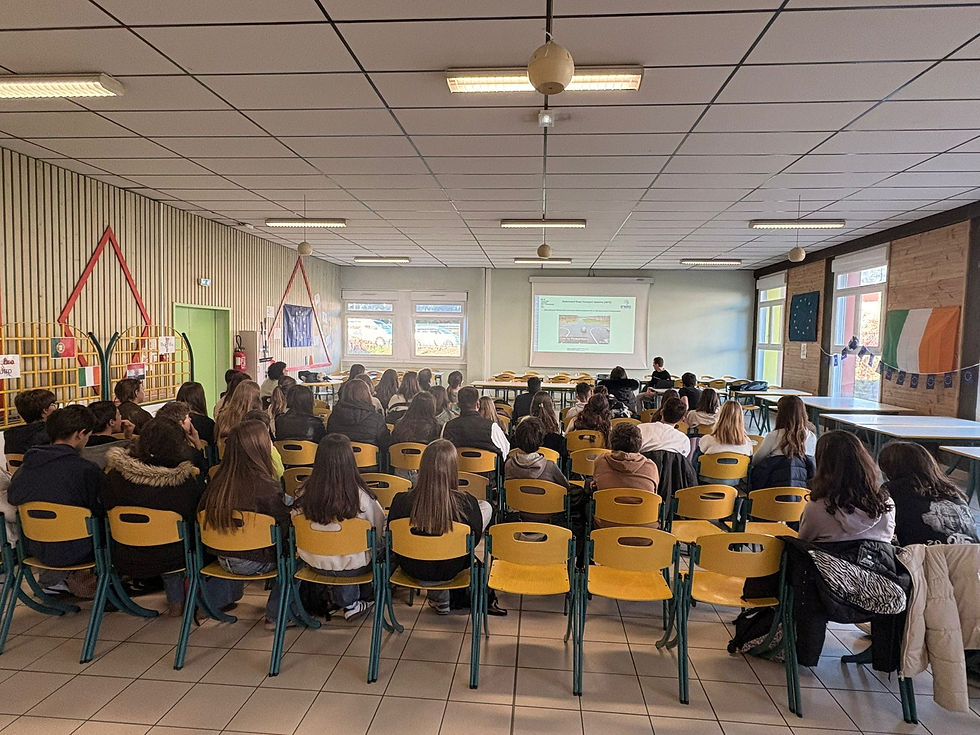
Students then took part in two final workshops. The first workshop examined how autonomous vehicles use Artificial Intelligence to interpret their surroundings and make decisions. Students discussed how sensors, machine learning and algorithms allow vehicles to operate safely.
The second workshop encouraged students to reflect on the ethical dimensions of Artificial Intelligence. Working in international teams, students created posters exploring what AI can do and what it must not do. This activity helped students summarise the key lessons of the week and think about the responsible use of technology.
The week concluded with a closing ceremony, during which every participant received a diploma recognising their active participation and contribution to the project. The certificates symbolised not only the knowledge gained but also the cooperation and friendships developed during the mobility.
Alongside the student activities, teachers coordinators participated in intensive collaborative sessions focused on developing educational resources for the project.
Over the course of the week nine teachers and lecturers worked together for approximately nine hours developing two Massive Open Online Courses (MOOCs). These sessions were coordinated and led by Daniela Usmiani.
The first course is designed for teachers and focuses on how Artificial Intelligence can be used responsibly in the classroom. It includes modules covering the history of AI, basic principles, ethical considerations, environmental impact and practical applications across subjects such as language learning, art, music, storytelling and STEM.
The second course is designed for students and introduces the foundations of Artificial Intelligence in an accessible way. It explores how AI works, the ethical and environmental implications of its use and how AI tools can be used for creative digital content.
These collaborative sessions were extremely productive and will result in valuable learning materials that can be shared with schools across Europe.

Impact of the week

The Albertville mobility had a strong impact on both students and teachers.
Students developed a deeper understanding of Artificial Intelligence and gained valuable insight into the environmental consequences of digital technologies. Learning about the energy consumption of AI models and data centres helped them realise that technological innovation must always be balanced with sustainability.
Working in international teams also strengthened students’ communication skills, confidence and cultural awareness. Friendships formed across borders and students experienced the true spirit of European cooperation.
For teachers, the week provided valuable professional development. The lectures, workshops and collaborative MOOC development sessions allowed educators to exchange expertise and develop new ways to teach Artificial Intelligence and sustainability in their own schools.
Final thoughts...
The success of LTTA 4 was made possible thanks to the exceptional organisation and hospitality of the French hosts. All of them created an atmosphere of warmth and enthusiasm that made the week truly unforgettable.
Participants left Albertville with new knowledge, stronger partnerships and a deeper understanding of how innovation and environmental responsibility must go hand in hand.
For many students and teachers, the week in Albertville will be remembered as one of the highlights of the SMAILE project and a powerful example of what Erasmus+ cooperation can achieve.
Memories...
LTTA 4 Workshops & Lectures
Our fourth Learning, Teaching, and Training Activity (LTTA 4) in Albertville, was a dynamic and enriching experience for both students and teachers. Hosted at College La Combe de Savoie , this week-long event provided more enrichment aspects about Artificial Intelligence (AI) through interactive workshops and interesting lectures. Each day offered valuable learning opportunities, with participants gaining hands-on experience in AI applications, critical thinking, and collaboration.
Workshop 1: AI Audioguide
In this workshop, students used AI to create an audioguide for exploring the medieval city of Conflans .
They combined translation tools and voice generation technologies to produce audio content for a real-life visit.
Process:
-
Explore information about the city
-
Translate texts into their own language using AI
-
Convert the text into audio using AI voice tools
-
Create and download several audio files
Outcome:
Students produced a multilingual audioguide, developing digital, linguistic, and creative skills while connecting AI with real-world experiences.

Workshop 2: AI assisted music creation
In this workshop, led by Mrs. Sabine Baron, students explored how AI can be used creatively to compose music and create audiovisual content.
Participants generated their own song using AI tools, transformed it into a video, and added subtitles, like a karaoke.
Process
-
Write lyrics using AI LMM like Chatgpt, Gemini...
-
Generate the song with an AI music platform: SUNO
-
Convert the audio into video format: freeconvert.com
-
Add subtitles to complete the final product:Veed.io
Outcome
Each student created their own AI-generated music video with subtitles, developing creativity and digital skills throughout the process.

Workshop 3: AI environmental comparison
In this workshop, led by Mrs. Sabine Baron, students explored different artificial intelligence tools and reflect on their environmental impact and energy consumption .
Participants used a comparison platform to test different AI models by giving them the same prompt and analyzing their responses.
Process:
-
Compare different AI models using a dedicated website
-
Analyze answers to the same prompt
-
Identify differences in performance and efficiency
-
Reflect on the environmental impact of AI
Outcome:
Students selected the best-performing AI and the most energy-efficient model, developing critical thinking and awareness of sustainable technology use.
Workshop 4: AI podometer
In this workshop, students explored how artificial intelligence can be used to recognize and interpret human movements through a micro:bit device. They discovered how built-in sensors, such as the accelerometer, can detect motion and how this data can be enhanced using machine learning. By combining coding and AI, students created interactive systems capable of responding to physical actions.
Process:
-
Program basic movements using the micro:bit (tilt, shake)
-
Train a machine learning model to recognize specific actions
-
Integrate the AI model into interactive programs
-
Test and improve the system through hands-on activities
Outcomes:
Students created AI-based projects such as activity counters, timers, or interactive systems, gaining hands-on experience with machine learning, coding, and motion recognition.

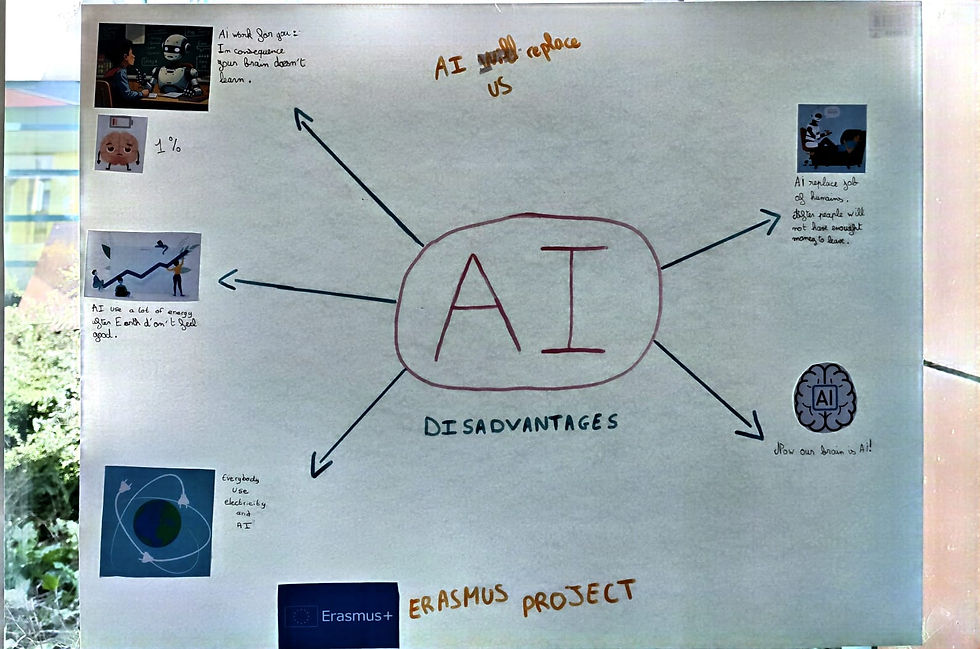

Workshop 5: Posters about AI risks
In this workshop, led by Mrs. Sabine Baron, students reflected on the risks and impact of artificial intelligence on society and the environment .
Working in teams, they designed an awareness poster aimed at teenagers and the general public, using clear messages and impactful visuals.
Process:
-
Research the effects of AI on thinking, brain development, and the environment
-
Analyze information from videos and prior learning
-
Collaborate in groups to develop ideas
-
Create a poster with strong images and clear messages
Outcome:
Students producee an awareness poster about AI, developing critical thinking, creativity, and a responsible perspective on technology.


Workshop 6: Autonomous cars
During this hands-on workshop, students explored the concept of autonomous vehicles by working in teams to design their own Automated Road Transport System (ARTS). The activity was based on real-life scenarios such as robotaxis, delivery robots, automated shuttles, and autonomous trucks operating in different environments.
Process:
-
Design an autonomous vehicle by selecting appropriate sensors
-
Identify and integrate necessary roadside infrastructure
-
Define how a remote operation center could support the system
-
Justify all their technical and operational decisions
Outcome:
This activity allowed participants to better understand how AI, infrastructure, and human supervision interact in autonomous transport systems.
Lecture´s content

Autonomous cars & french regulation
This lecture, led by Leo Maisonobe, from STRMTG, introduced students to how artificial intelligence is used in autonomous vehicles and the challenges involved in making these systems safe and reliable .
Participants discovered how self-driving systems perceive their environment using sensors such as cameras, LiDAR, and radar, and how AI processes this data to make driving decisions. The session also explored the limits of these technologies and the importance of combining AI with safety mechanisms.
In addition, the talk provided an overview of European and French regulations, highlighting how high-risk AI systems—such as autonomous vehicles—are tested, validated, and controlled.
What´s next?
Local workshops for students and teachers developed after this Learning Training and Teaching meeting in each partner school.
Timing: march-june 2026