![eu_flag_co_funded_pos_[rgb]_right.jpg](https://static.wixstatic.com/media/80fbcc_c6836960a228406f81cf3f79457e00df~mv2.jpg/v1/fill/w_211,h_62,al_c,q_80,usm_0.66_1.00_0.01,enc_avif,quality_auto/eu_flag_co_funded_pos_%5Brgb%5D_right.jpg)


4rd. Learning Training Teaching activity
9-13 mar 2026
Albertville. France
Workshops & Lectures


Workshop 1: AI Audioguide
In this workshop, students used AI to create an audioguide for exploring the medieval city of Conflans .
They combined translation tools and voice generation technologies to produce audio content for a real-life visit.
Process:
-
Explore information about the city
-
Translate texts into their own language using AI
-
Convert the text into audio using AI voice tools
-
Create and download several audio files
Outcome:
Students produced a multilingual audioguide, developing digital, linguistic, and creative skills while connecting AI with real-world experiences.


Workshop 2: AI assisted music creation
In this workshop, led by Mrs. Sabine Baron, students explored how AI can be used creatively to compose music and create audiovisual content.
Participants generated their own song using AI tools, transformed it into a video, and added subtitles, like a karaoke.
Process
-
Write lyrics using AI LMM like Chatgpt, Gemini...
-
Generate the song with an AI music platform: SUNO
-
Convert the audio into video format: freeconvert.com
-
Add subtitles to complete the final product:Veed.io
Outcome
Each student created their own AI-generated music video with subtitles, developing creativity and digital skills throughout the process.


Workshop 3: AI environmental comparison
In this workshop, led by Mrs. Sabine Baron, students explored different artificial intelligence tools and reflect on their environmental impact and energy consumption .
Participants used a comparison platform to test different AI models by giving them the same prompt and analyzing their responses.
Process:
-
Compare different AI models using a dedicated website
-
Analyze answers to the same prompt
-
Identify differences in performance and efficiency
-
Reflect on the environmental impact of AI
Outcome:
Students selected the best-performing AI and the most energy-efficient model, developing critical thinking and awareness of sustainable technology use.


Workshop 4: AI podometer
In this workshop, students explored how artificial intelligence can be used to recognize and interpret human movements through a micro:bit device. They discovered how built-in sensors, such as the accelerometer, can detect motion and how this data can be enhanced using machine learning. By combining coding and AI, students created interactive systems capable of responding to physical actions.
Process:
-
Program basic movements using the micro:bit (tilt, shake)
-
Train a machine learning model to recognize specific actions
-
Integrate the AI model into interactive programs
-
Test and improve the system through hands-on activities
Outcomes:
Students created AI-based projects such as activity counters, timers, or interactive systems, gaining hands-on experience with machine learning, coding, and motion recognition.

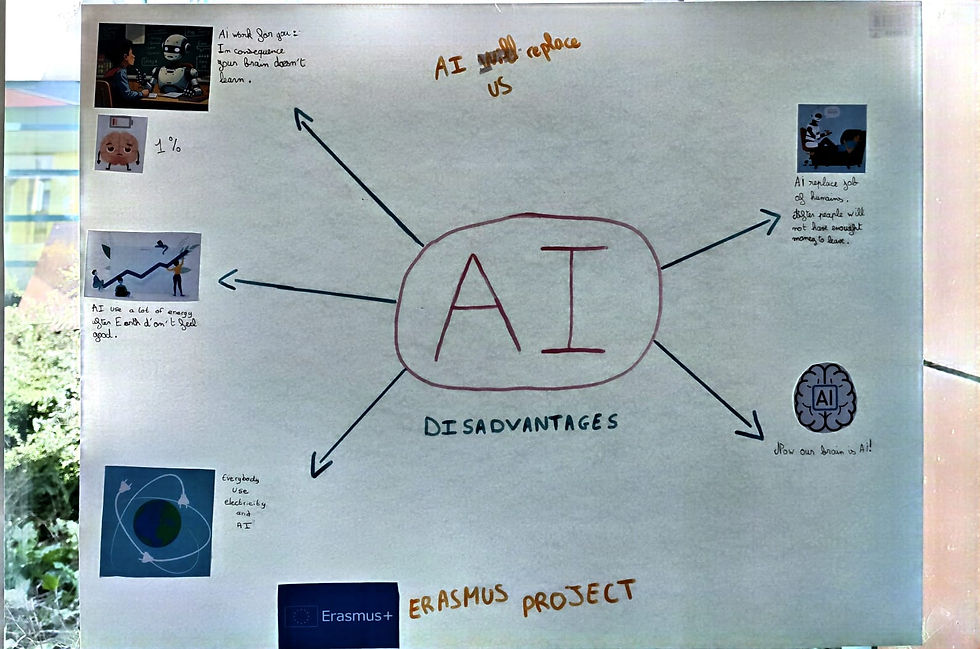

Workshop 5: Posters about AI risks
In this workshop, led by Mrs. Sabine Baron, students reflected on the risks and impact of artificial intelligence on society and the environment .
Working in teams, they designed an awareness poster aimed at teenagers and the general public, using clear messages and impactful visuals.
Process:
-
Research the effects of AI on thinking, brain development, and the environment
-
Analyze information from videos and prior learning
-
Collaborate in groups to develop ideas
-
Create a poster with strong images and clear messages
Outcome:
Students producee an awareness poster about AI, developing critical thinking, creativity, and a responsible perspective on technology.


Workshop 6: Autonomous cars
During this hands-on workshop, students explored the concept of autonomous vehicles by working in teams to design their own Automated Road Transport System (ARTS). The activity was based on real-life scenarios such as robotaxis, delivery robots, automated shuttles, and autonomous trucks operating in different environments.
Process:
-
Design an autonomous vehicle by selecting appropriate sensors
-
Identify and integrate necessary roadside infrastructure
-
Define how a remote operation center could support the system
-
Justify all their technical and operational decisions
Outcome:
This activity allowed participants to better understand how AI, infrastructure, and human supervision interact in autonomous transport systems.
Lecture´s content

Autonomous cars & french regulation
This lecture, led by Leo Maisonobe, from STRMTG, introduced students to how artificial intelligence is used in autonomous vehicles and the challenges involved in making these systems safe and reliable .
Participants discovered how self-driving systems perceive their environment using sensors such as cameras, LiDAR, and radar, and how AI processes this data to make driving decisions. The session also explored the limits of these technologies and the importance of combining AI with safety mechanisms.
In addition, the talk provided an overview of European and French regulations, highlighting how high-risk AI systems—such as autonomous vehicles—are tested, validated, and controlled.